
Igor Stravinsky
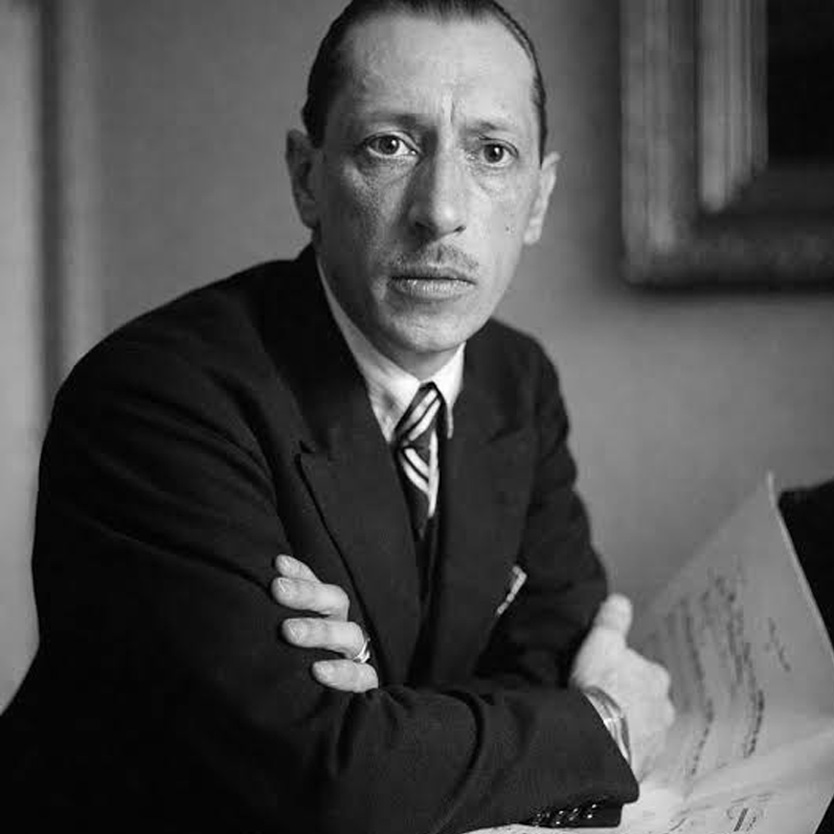
“Aristotle’s Poetics constantly suggest ideas regarding personal work, arrangement of materials, and structure. The poetics of music is exactly what I am going to talk to you about; that is to say, I shall talk about making in the field of music.”
Igor Stravinsky is one of the top five most influential composers of music in the 20th century. This book was a transcription of a series of lectures he gave at Harvard in 1940. His thoughts are worth studying and inspirational for further creativity.
At our music school in Dallas, Texas we believe that music is more than sound, it is relationships. We teach students how to relate to one another in collaborative endeavors, as well as how to relate to themselves in their own creativity.
When I had one of the movements of my Fourth String Quartet premiered in Maine, some years ago, Laura Kaminsky (who that year had one of her compositions debuted as #3 on the Classical Billboard charts) commented favorably that she could hear the influence of Stravinsky in my writing. My first serious study and analysis in college was of Stravinsky’s Dumbarton Oaks, and since then I have been an eager student of his works.
Following are the main points in the book:
- “Art is by essence constructive. Revolution implies a disruption of equilibrium. To speak of revolution is to speak of a temporary chaos. Now art is the contrary of chaos. It never gives itself up to chaos without immediately finding its living works, its very existence, threatened…A musical complex, however harsh it may be, is legitimate to the extent to which it is genuine.”
At our music school in Dallas, Texas we encourage students to explore new ideas based upon time-tested disciplines that bring structure out of chaos.
- “I conclude that tonal elements become music only by virtue of their being organized, and that such organization presupposes a conscious human act…It simply presupposes that the basis of musical creation is a preliminary feeling out, a will moving first in an abstract realm with the object of giving shape to something concrete. The elements at which this speculation necessarily aims are those of sound and time. Music is inconceivable apart from those two elements.”
- “Modality, tonality, polarity are merely provisional means that are passing by, and will even pass away. What survives every change of system is melody…melody must keep its place at the summit of the hierarchy of elements that make up music. Melody is the most essential of these elements, not because it is more immediately perceptible, but because it is the dominant voice of the symphony – not only in the specific sense, but also figuratively speaking.”
We help students at our music school in Dallas, Texas value melodic development, which is what J.S. Bach did with his students, encouraging them to learn the art of the cantabile style of playing (i.e. the ‘singing’ style of playing). He went on to encourage his composition students in the same context, showing through demonstration how to write linearly.
- “The study of the creative process is an extremely delicate one…All creation presupposes at its origin a sort of appetite that is brought on by the foretaste of discovery…We have a duty towards music, namely, to invent it…Invention presupposes imagination but should not be confused with it…invention is not conceivable apart from its actual being worked out. Thus, what concerns us here is not imagination in itself, but rather creative imagination: the faculty that helps us to pass from the level of conception to the level of realization.”
At our music school in Dallas, Texas we teach that the skill of the composer is to ‘capture’ his ideas. A great place to start is to develop the skill of transcription.
- “My freedom thus consists in my moving about within the narrow frame that I have assigned myself for each one of my undertakings. I shall go even further: my freedom will be so much the greater and more meaningful the more narrowly I limit my field of action and the more I surround myself with obstacles. Whatever diminishes constraint, diminishes strength. The more constraints one imposes, the more one frees one’s self of the chains that shackle the spirit.”
The great mystery of life and music is that greater freedom comes out of greater discipline. We help students at our music school in Dallas, Texas develop a high level of discipline, which in turn frees them to create and perform at the highest levels.
- “Conductors, singers, pianists, all virtuosos should know or recall that the first condition that must be fulfilled by anyone who aspires to the imposing title of interpreter, is that he be first of all a flawless executant. The secret of perfection lies about all in his consciousness of the law imposed upon him by the work he is performing. And here we are back at the great principle of submission that we have so often invoked in the course of our lessons. This submission demands a flexibility that itself requires, along with technical mastery, a sense of tradition and, commanding the whole, an aristocratic culture that is not merely a question of acquired learning.”
The role of the performer is to serve the work being performed. At our music school in Dallas, Texas we help students appreciate the value of learning to serve, not only the music, but the audience and community, as well.
- “‘Music,’ says the Chinese sage Seu-ma-tsen in his memoirs, ‘is what unifies.’ This bond of unity is never achieved without searching and hardship. But the need to create must clear away all obstacles. I think at this point of the gospel parable of the woman in travail who ‘hath sorrow, because her hour is come: but as soon as she is delivered of the child, she remembereth no more the anguish, for joy that a man is born into the world.’ How are we to keep from succumbing to the irresistible need of sharing with our fellow men this joy that we feel when we see come to light something that has taken form through our own action? For the unity of the work has a resonance all its own. Its echo, caught by our soul, sounds nearer and nearer. Thus the consummated work spreads abroad to be communicated and finally flows back towards its source. The cycle, then, is closed. And that is how music comes to reveal itself as a form of communion with our fellow man – and with the Supreme Being.”